In financial services, many firms are focused on providing bottom-line value to their clients. What most of them forget is how to properly communicate that value.
A good PR strategy has a greater impact on the bottom line than most firms realise. This book shows how to put in place an effective PR program in the financial services industry, and how great communications can add significant value to a firm.
Between them, Claudia Pritchitt and Leeanne Bland have over 50 years’ experience in public relations, communications, and marketing. Here, they explain the key tools needed in an effective communications strategy as well as why plain English is imperative in the jargon-heavy world of financial services.
Over the week, the net number of financial advisers only increased by one, this is despite 10 new entrants commencing. This highlights that a net of nine experienced advisers ceased. Two new licensees commenced and none ceased. A total of 54 advisers were affected by resignations / appointments.
For a second week in a row, not one licensee owner increased by more than one adviser.
Is this the calm before the storm? The past few weeks of reporting has shown the adviser market to be relatively flat with just a few key movements per week. We all know this will soon change as we head into the last month of the calendar year and start 2026 with new education requirements for advisers.
Looking at additional data from ASIC with regards to the Experienced Pathway and 2026 qualifications, indications are that a large number of advisers will exit – see below further details.
Key adviser movements for this period
Net change of advisers +1
Current number of advisers 15,459
Net change calendar 2025 YTD (-12)
Net change 2025 YTD of +143 when excluding licensees that provide mostly limited SMSF advice
Net change financial YTD (2025/26) +289
Net change Financial YTD +306 when excluding licensees that provide mostly limited SMSF advice
27 licensee owners had net gains of 27 advisers
19 licensee owners had net losses for (-25) advisers
2 new licensees, and none ceased
10 new entrants
Growth – licensee owners
All licensee owners that gained advisers increased by just one, including Spark Partnership Group, Shartru and Rhombus. Both new licenses commenced with one adviser each.
Centrepoint, currently the third largest advice group, also added one new adviser (a new entrant) and are now at 587 advisers, just two behind Count Limited with 589. Entireti & Akumin Group are at 1,104 advisers.
Losses – licensee owners
Sequoia Group is down by three, with one commencing their own licensee, and the remaining two advisers yet to be appointed elsewhere
Four licensee owners are down by two each:
Capstone Financial - both advisers not appointed elsewhere to date
Cobalt Advisers - one switching to RI Advice owned by Rhombus, the other not appointed elsewhere
GPG Unit Pty Ltd (Godfrey Pembroke) - both advisers switching to Findex
River X, one switching to Advisory Circle Pty Ltd and the other yet to be appointed elsewhere.
A short tail of 14 licensee owners down by net one each including Entireti & Akumin Group, Finchley and Kent, and Shaw and Partners.
Experienced pathway analysis – adviser losses and consequences
ASIC recently released another one-time extract of the FAR, showing how many advisers plan to use the EP and details on adviser qualifications needed for 2026. We have analysed this data and provided an indication has to how many advisers might stay on the FAR in Jan 2026.
Our ongoing analysis of ASIC’s ‘one-off, point-in-time’ Financial Adviser Register (FAR) data, highlighting the advisers progression with the Experienced Pathway and 2026 qualifications, now paints the clearest picture yet of the seismic shift heading toward the financial advice profession.
With the 1 January 2026 education standards rapidly approaching, the data shows the financial adviser market is on the verge of a significant contraction and one that will redefine adviser capacity, business models, and consumer access to advice.
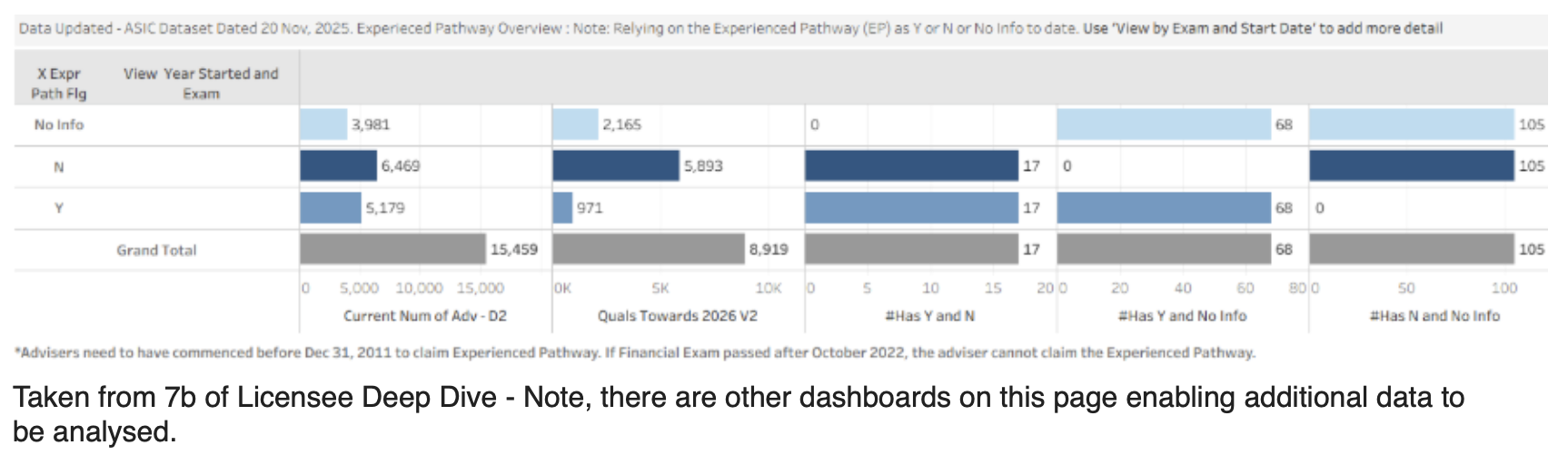
Comparing ASIC’s November point-in-time data with today’s FAR, we have identified the three clear adviser cohorts (see also chart below):
5,179 advisers intend to use the Experienced Pathway (EP)
6,469 advisers say they will not use the EP
3,981 advisers have provided no information
The responses above total 15,629 adviser entries, exceeding the actual adviser population of 15,459 due to multi-authorised advisers supplying conflicting data to ASIC. Note: We adjust for these duplicates in the “No Info” segment.
We have also broken the data down further into sectors by commencement dates of advisers, to assist in determining the potential of additional advisers who may be able to proceed with the EP. We have also segmented by qualifications, noting that ASIC’s “qualification progressing toward standards” flag does not guarantee an adviser will be fully qualified for 2026.
Our analysis breaks the data into three core segments:
A — Advisers intending to use the experienced pathway
5,179 advisers have said they will rely on the EP
59 advisers passed the Financial Adviser Exam after the cut-off (Oct 2022) to qualify for the EP
183 advisers appear to have commenced after Jan 2011 (potentially ineligible)
FAR commencement dates can be unreliable, so EP declarations will be the stronger indicator — but not all who said “Yes” will qualify.
B — Advisers who will not use the EP
6,469 advisers have declared they will not use the EP, and 91 per cent hold qualifications counting toward 2026.
This group appears relatively stable
Together, cohorts A and B total 11,648advisers and we would expect the greater majority to continue into 2026
C — No info - advisers who have not declared their intentions
After adjusting for duplicates, some 3,811 advisers fall into the “No Info” category:
1,523 advisers potentially qualify for the EP (commenced pre-Dec 2011)
An additional 1,396 advisers with qualifications that indicate they may progress toward 2026
2919 advisers in this cohort may able to proceed into 2026.
This group remains the largest uncertainty.
Padua’s forecast for 2026
A ‘best case’ adviser population of 14,567 and this is currently 892 fewer than today’s total of 15,459.
When a series of ‘what if’ scenarios are performed, the net loss can easily jump in excess of 1,600.
Adding together the most realistic outcomes across all categories the net loss range will be between 1,100 and 1,500.
Factors that can distort the numbers
The traditional December resignation spike
Advisers gaining qualifications only to exit shortly after - this occurred when the first ‘FASEA’ Financial Adviser Exams commenced
EP declarations failing due to service periods being checked
November Financial Adviser exam resulting in a surge of new entrants helping to soften the losses
Last-minute December FAR updates distorting the current view of the data
What this means for the advice profession
A significant drop in advisers will have immediate implications:
Higher client loads per adviser
Longer turnaround times for advice
Increased cost-to-serve pressures
A fight for new advisers and to bring back experienced advisers
Reduced consumer access to professional advice.
We expect that advisers and licensees will seek need to leverage an advice generation platform that:
Produces high-quality, compliant advice quickly
Enables advisers to scale from 100 clients to 200+ without additional staff
Eliminates administrative drag
Reduces the cost of producing advice
Improves turnaround times
Supports consistent, repeatable, defendable advice at scale
A highly efficient advice generation is no longer a “nice to have”.